Starting in February, 2019, you’ll have the option to have 100% of your power come from clean power sources. This change will significantly reduce our carbon emissions as a city, and contribute to a healthier, clean environment we can all enjoy. The best part is, you don’t have to do a thing!
The Clean Power Alliance (CPA) will begin purchasing 100% Green Power for all Santa Monica residential customers (businesses will transition to the same system in Summer 2019). Power delivery, billing, and customer service will remain with Southern California Edison (SCE).
Here’s a video created by our friends at the City of Santa Monica explaining who the CPA is and how the new system works.
The Santa Monica City Council elected to have 100% Green Power be the default. That means, as a customer, you don’t have to do a thing to begin receiving 100% Green Power after February. All California Alternate Rates for Energy (CARE) customers will receive 100% Green Power and their low-income discounts, just as before with no net increase to their bills.
If 100% isn’t a fit for you, no problem. You now have the power of choice! The Clean Power Alliance will offer 3 different tiers of Green Power.
100% Green Power (7-9% increase compared to SCE),
50% Clean Power (0-1% discount compared to SCE), or
36% Lean Power (1% discount compared to SCE).
You can also elect to remain with SCE for all your power needs, but we encourage you to give the Clean Power Alliance options a try and help us significantly reduce our carbon emissions with little to no effort or cost required.
Interested in learning more? The City of Santa Monica’s Office of Sustainability and the Environment are hosting meetings this month, near you, to discuss the transition and answer any questions you might have.
January 7 at 7 p.m.: Virginia Avenue Park Advisory Board, Virginia Avenue Park
January 7 at 7 p.m.: Santa Monica Northeast Neighbors, Montana Avenue Library
January 8 at 7 p.m.: Wilshire Montana Neighborhood Coalition, Montana Avenue Library
January 9 at 9 a.m.: Chamber of Commerce SBC, Chamber of Commerce
January 10 at 7 p.m.: Pico Neighborhood Association, Thelma Terry Building at Virginia Avenue Park
January 13 at 6:30 p.m.: Committee for Racial Justice, Thelma Terry Building at Virginia Avenue Park
January 14 at 7 p.m.: Ocean Park Association, Marine Park Auditorium
January 16 at 6 p.m.: Electric Vehicle Subcommittee, Virginia Avenue Park
January 17 at 7 p.m.: Friends of Sunset Park, Mt. Olive Church
January 21 at 7 p.m.: Task Force on the Environment, Virginia Avenue Park
ClimateFest is a free community event that will celebrate and inspire climate action, co-produced by the City of Santa Monica and Climate Action Santa Monica.
8:30 AM – Bike Ride with the Mayor (from City Hall)
9AM – Registration
10 AM – Opening Ceremony
10:30 AM – Green Living Festival
11:00 AM – Presentations, Workshops, Family Bike Hub, Clean Vehicle Ride & Drive
12:30 PM – Lunch & Keynote
3:30PM Community Voices on Climate Action
5:00 PM Networking Social Hour
Kids Activities & Childcare available. Free bike valet will be available; Breeze bikes can be parked at the bike valet without incurring the $2 out-of-hub fee. Big Blue Bus lines 1, 2, 9 and 18 are a short walk from the venue. Limited parking available onsite.
We welcome whatever amount of participation you can contribute. ClimateFest will have activities all day (9 AM – 6 PM) starting early with a “Bike Ride with the Mayor” arriving at St. Monica’s at 9:30 AM and ending with a Social Hour. Once on site, attendees will have choices as to how they wish to participate. Organizers will post the final schedule in advance so you can better plan your day and begin to make choices as to which workshops, talks, and activities to attend.
Are children allowed to attend?
Children are welcome to attend. We will have kid-centric activities and childcare available.
What if I don’t live in Santa Monica?
If you work in Santa Monica or visit often, your voice is important too and you are welcome to attend!
Where can I learn more about climate change in Santa Monica and Los Angeles?
Local climate change impacts have been modeled and projected for the LA region. To learn more, visit www.kcet.org/climate-change-la.
Where can I learn more about climate action in Santa Monica?
The Office of Sustainability and the Environment is responsible for the City’s climate action planning efforts. To learn more, visit www.sustainablesm.org/climate.
What the heck is Pecha Kucha?
Pecha Kucha was devised in Tokyo in 2003 as an event for young designers to meet, network, and show their work in public. Pecha Kucha is a simple presentation format where you show 20 images, each for 20 seconds for a total of 6 min and 40 sec. The images advance automatically and you talk along to the images. We are inviting you to submit your own Pecha Kucha talk to present at the Summit! Contact gina.garcia@sustainableworks.org for details.
Loss of water from the rocks of California’s Sierra Nevada caused the mountain range to rise nearly an inch (24 millimeters) in height during the drought years from October 2011 to October 2015, a new NASA study finds. In the two following years of more abundant snow and rainfall, the mountains have regained about half as much water in the rock as they had lost in the preceding drought and have fallen about half an inch (12 millimeters) in height.
“This suggests that the solid Earth has a greater capacity to store water than previously thought,” said research scientist Donald Argus of NASA’s Jet Propulsion Laboratory in Pasadena, California, who led the study. Significantly more water was lost from cracks and soil within fractured mountain rock during drought and gained during heavy precipitation than hydrology models show.
Argus is giving a talk on the new finding today at the American Geophysical Union’s fall conference in New Orleans.
The research team used advanced data-processing techniques on data from 1,300 GPS stations in the mountains of California, Oregon and Washington, collected from 2006 through October 2017. These research-quality GPS receivers were installed as part of the National Science Foundation’s Plate Boundary Observatory to measure subtle tectonic motion in the region’s active faults and volcanoes. They can monitor elevation changes within less than a tenth of an inch (a few millimeters).
The team found that the amount of water lost from within fractured mountain rock in 2011-2015 amounted to 10.8 cubic miles of water. This water is too inaccessible to be used for human purposes, but for comparison, the amount is 45 times as much water as Los Angeles currently uses in a year.
JPL water scientist Jay Famiglietti, who collaborated on the research, said the finding solves a mystery for hydrologists. “One of the major unknowns in mountain hydrology is what happens below the soil. How much snowmelt percolates through fractured rock straight downward into the core of the mountain? This is one of the key topics that we addressed in our study.”
Earth’s surface falls locally when it is weighed down with water and rebounds when the weight disappears. Many other factors also change the ground level, such as the movement of tectonic plates, volcanic activity, high- and low-pressure weather systems, and Earth’s slow rebound from the last ice age. The team corrected for these and other factors to estimate how much of the height increase was solely due to water loss from rock.
Before this study, scientists’ leading theories for the growth of the Sierra were tectonic uplift or Earth rebounding from extensive groundwater pumping in the adjoining California Central Valley. Argus calculated that these two processes together only produced a quarter of an inch (7 millimeters) of growth — less than a third of the total.
Famiglietti said the techniques developed for this study will allow scientists to begin exploring other questions about mountain groundwater. “What does the water table look like within mountain ranges? Is there a significant amount of groundwater stored within mountains? We just don’t have answers yet, and this study identities a set of new tools to help us get them.”
A paper on the research, titled “Sustained water loss in California’s mountain ranges during severe drought from 2012 through 2015 inferred from GPS,” was published in the Journal of Geophysical Research: Solid Earth.
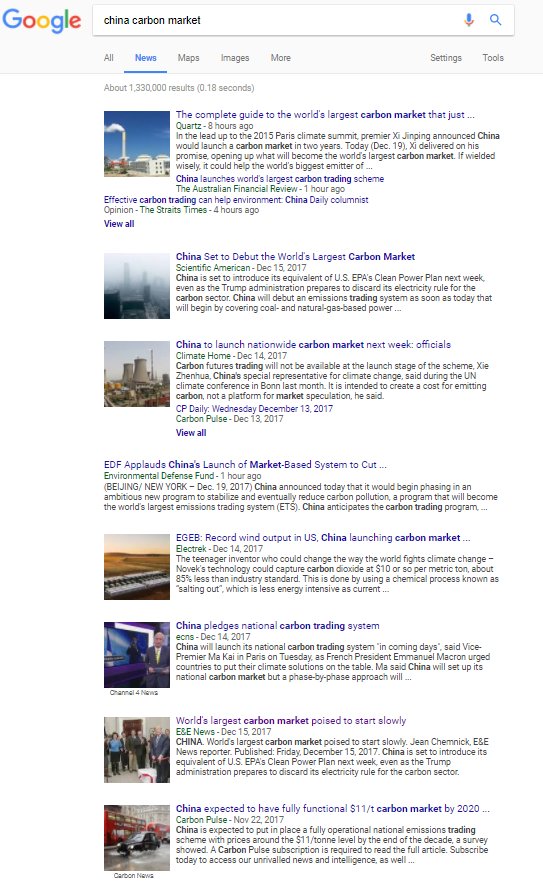
On December 19, China officially announced that it would create the world’s largest carbon trading system, meant to help the country meet its ambitious climate change and clean energy targets. (The country wants to get 20 percent of its energy from renewables, and peak its emissions, by 2030.)
It can be difficult for Americans, most of whom don’t track China’s carbon policy very closely, to understand the significance of such developments, so let’s try to put it in context.
To make a long story short: Yes, a comprehensive carbon trading system covering the world’s largest emitter will, eventually, be a Very Big Deal. But Tuesday’s announcement was neither the beginning nor the completion of that effort, only a signpost on a path that the country is navigating with great care.
It’s an exciting signpost, though!
Debating the finer points of climate policy. Thomas Peter – Pool/Getty Images
China is building its carbon trading system slowly and deliberately
Back in 2011, China’s government laid out a plan to gradually create a national carbon market. (It appeared in the country’s 12th Five-Year Plan, covering 2011-’15.) The key word here is gradually.
Over the ensuing years, the country established several provincial and city-level carbon-trading pilot projects, with varying rules, scopes, and baselines, to test-drive the concept.
Tuesday’s announcement confirmed China’s intention to move beyond pilot projects to a bona fide national system. Originally, the (insanely ambitious) plan was to expand the system to cover the entire Chinese economy in 2017, but on Tuesday leaders revealed that it will initially cover only the electricity sector — big coal and natural gas plants — which represents about a third of the country’s emissions.
Of course, this is China, so covering “only” the power sector would immediately make its trading system the world’s largest, covering roughly 3.5 billion tons of CO2. By comparison, the world’s current largest system (in the European Union) covers around 2 billion tons, and the biggest in the US (California’s) covers around 395 million tons.
Even trading in the power sector will not begin immediately, however. A few years will be spent gathering and verifying data on plant-level emissions, establishing rules and baselines, engaging in “dummy” trades as a stress test, and generally setting the table. Actual trading, with money changing hands, will begin in 2020. The system will expand to cover other sectors like steel, concrete, and aviation at some unspecified post-2020 date.
We still don’t know much about how this will actually work
China has confirmed that there will be a carbon trading system, but the vast bulk of the important operational details remain unknown.
Most notably, the country did not say where it would set its carbon cap. This is obviously a key feature, since it determines the environmental effects of the system. And it’s particularly fraught in China’s case, because emissions are already slowing based on economic shifts and other policies. If the cap is too high/cautious, as has been the case in virtually every other cap-and-trade system to date, carbon prices will stay low and the system won’t have much effect. (This is arguably true of the EU’s system; it moves lots of money around, but the cap is so weak that other, national-level policies are doing more actual carbon-reduction work.)
Other important details also went unspecified: There’s no word on how many allowances will be distributed for free versus auctioned, what baselines and procedures will be used, or how the system will fit with China’s many other non-market policies to reduce emissions.
These may seem like wonky details, but existing cap-and-trade systems have arguably botched them. China has been in intensive discussions with representatives from California and the EU, seeking to learn from their mistakes.
Eyes on the prize: moving up China’s 2030 peak
So that’s where we are: a power sector trading system, up and running in 2020, with an unknown cap and unknown rules, which will expand further at some unknown date. What to make of all this?
Coverage of China’s announcement has been a little, uh, heated.
Not one word yet on content of China’s carbon market announcement but the hype train has already left the station and disappeared in the horizon. Let’s see first what is actually getting announced.
Conservatives, meanwhile, remain stubbornly unimpressed. “I don’t take the carbon market seriously,” Derek Scissors of the conservative think tank American Enterprise Institute told the New York Times, “The first thing I would ask people is, ‘What markets in China do you think work really well?’”
Conservatives are, of course, heavily invested in the notion that China is faking and/or failing on climate policy — it’s long been one of their primary justifications for opposing ambitious US climate policy. It was one of Trump’s rationales for pulling out of the Paris climate agreement.
But climate hawks are equally invested in the notion that China is racing ahead, since that serves as a cudgel with which to attack conservatives. They have considerable incentive to lionize China.
I think the right take here is some version of cautious optimism. Climate hawks have the better of the argument — China is deadly serious about cleaning up its energy system, not only or even primarily for climate reasons — but conservative warnings about China’s history of opacity and cronyism are worth heeding.
The key thing to remember is that China’s government thinks long term. (There’s nothing in China like vertiginous Obama-Trump transitions, needless to say.) It is planning for the rest of the century, for China to become a leading global power, especially in clean energy. Relative to the scale and scope of the task at hand, taking a few more years to get it right is a small sacrifice.
The other thing to remember is just how mind-bogglingly huge the challenge is. China is really, really big. It has grown, since 2000, from a poverty-stricken backwater to the world’s largest economy, mainly powered by coal. It is attempting to create a modern economy and a modern government in a fraction of the time it took wealthy Western nations to do the same. The effects of rapid growth are everywhere, especially in the central government’s scramble to bring far-off provincial governments in line. In many cases, the central government lacks data on what is emitting what, and where — such data is often massaged or manipulated by companies and provincial leaders over which the central government still has only tenuous control.
China’s government is acutely aware of the importance of its carbon efforts, both politically and environmentally, and of the daunting challenges it faces in creating one. So despite the urgency of the climate challenge, its highest imperative is not speed. The most important thing is getting the baselines, rules, and procedures right, creating a functioning system that can be used as a ratchet for decades to come.
In 2020, China will issue two important documents: its next Five-Year Plan and its updated NDC (its pledged targets under the Paris climate agreement). The international climate talks being held in 2020 will be the first chance for countries to increase their ambitions and ratchet up their original NDCs. All eyes will be on China.
Getting a stable, effective carbon trading system in place — even if the initial cap is weak, as it likely will be — could help embolden China to set a more ambitious timeline for peaking its emissions, perhaps 2025 or even earlier. Moving up a peak by five years may not sound like much, but for the world’s most populous country, its largest economy, and its biggest emitter, that represents the emissions equivalent of several small countries going to zero. It would be a seismic development, bolstering other countries to boost their ambitions in turn.
Anyway, we are impatient here in the US, but the fact is, China is moving deliberately and cautiously on this. And that’s good news. If China gets carbon trading right, the effects — direct effects on emissions and indirect political effects — will be beyond calculating. The more care, the better.
The time between Thanksgiving and Christmas is meant to be, in Southern California, the start of rainy season. Not this year. The Thomas Fire, the worst of those roiling the region this last week, grew 50,000 acres on Sunday alone; it has now burnt 270 square miles and forced 200,000 people from their homes. There is no rain forecast for the next seven to ten days, and as of Monday morning, Thomas is just, in the terrifying semi-clinical language of wildfires, “10% contained.” To a poetic approximation, it’s not a bad estimate of how much of a handle we have on the forces of climate change that unleashed it — which is to say, hardly any.
“The city burning is Los Angeles’s deepest image of itself,” Joan Didion wrote in “Los Angeles Notebook,” collected in Slouching Towards Bethlehem. But the cultural impression is apparently not all that deep, since the fires that broke out last week produced, in headlines and on television and via text messages, an astonished refrain of the adjectives “unthinkable,” “unprecedented,” and “unimaginable.” Didion was writing about the fires that had swept through Malibu in 1956, Bel Air in 1961, Santa Barbara in 1964, and Watts in 1965; she updated her list in “Fire Season (1989),” describing the fires of 1968, 1970, 1975, 1978, 1979, 1980, and 1982: “Since 1919, when the county began keeping records of its fires, some areas have burned eight times.”
We could use further updating: Five of the 20 worst fires in California history have now hit since just September, when 245,000 acres in Northern California burned — devastation so cruel and sweeping that two different accounts were published in two different local newspapers of two different aging couples taking desperate cover in pools as the fires swallowed their homes. One couple survived, emerging after six excruciating hours to find their house transformed into an ash monument; in the other, it was only the husband who emerged, his wife of 55 years having died in his arms. As Americans traded horror stories in the aftermath of those fires, they could be forgiven for mixing the stories up or being confused; that climate terror could be so general as to provide variations on such a theme seemed, as recently as September, impossible to believe.
But if last week’s wildfires were not unprecedented, what did we mean when we called them that? Like September 11, which followed several decades of morbid American fantasies about the World Trade Center, the brushfires that began last week north of Santa Paula look to a horrified public like a climate prophecy, made in fear, now made real.
That prophecy was threefold. First, the simple intuition of climate horrors — an especially biblical premonition when the plague is out-of-control fire, like a dust storm of flame. Second, of the expanding reach of wildfires in particular, which now can feel, in much of the West, like a gust of bad wind away, and never impossible no matter the time of year. Over the last few decades, the wildfire season has already grown by two months, and by 2050, destruction from wildfires is expected to double (for every additional degree of global warming, it will quadruple).
But perhaps the most harrowing of the ways in which the fires seemed to confirm our cinematic nightmares was the third: that climate chaos could breach our most imperious fortresses — that is, our cities. With Katrina, Sandy, Harvey, Irma, Americans have gotten acquainted with the threat of flooding, but water is just the beginning. In the affluent cities of the West, even those conscious of environmental change have spent the last few decades believing that, and behaving as though, we had — with our street grids, our highways, our superabundant supermarkets and all-everywhere, all-enveloping internet — built our way out of nature. We have not. A paradise dreamscape erected in a barren desert, L.A. has always been an impossible city, as Mike Davis, among many others, has so brilliantly written. The sight of flames straddling the eight-lane 405 is a reminder that it is still impossible. In fact, getting more so.
One response to seeing things long predicted actually come to pass is to feel that we have settled into a new era, with everything transformed. In fact, that is how Governor Jerry Brown described the state of things this weekend: “a new normal.” The fact that the news cycle has already moved on, while the fires are just as out of control, is another sign of our eagerness to normalize these horrors — or at least to look away. But normalization is problematic, as perversely comforting as it may feel to think we’ve settled into a familiar nightmare. Climate change is not binary, and we have not now arrived at a new equilibrium; as I’ve written before, the climate suffering we are seeing now is a “beyond best case” scenario for our future. With each further tick upward in global temperatures — each tiny tick — the effects will worsen. And further ticks are inevitable; the question is only how many. It would be much more accurate to say that we have passed beyond the end of normal, into a new realm unbounded by the analogy of any human experience.
But two big forces conspire to prevent us from normalizing fires like these, though neither is exactly a cause for celebration. The first is that extreme weather won’t let us, since it won’t stabilize — so that even within a decade, it’s a fair bet that these fires will be thought of as the “old normal.” Whatever you may think about the pace of climate change, it is happening mind-bendingly fast, almost in real time. It is not just that December wildfires were unheard of just three decades ago. We have now emitted more carbon into the atmosphere since Al Gore wrote his first book on climate than in the entire preceding history of humanity, which means that we have engineered most of the climate chaos that now terrifies us in that brief span.
The second force is also contained in the story of the wildfires — the way that climate change is finally striking close to home. Striking, in fact, some quite special homes: Last Thursday, for instance, there were reports that the fires were threatening the Getty Museum and Rupert Murdoch’s Bel-Air estate. There may not be two better symbols of the imperiousness of American money in the country.* One imagines that Murdoch will not be writing tweets like this one again anytime soon; then again, who knows?
When, on Thursday, Itweeted that NBC News was reporting that Murdoch’s vineyard was on fire, it immediately spawned a thread of gleeful, crowing responses, more than a thousand of them. But, of course, his property and the Getty were not being singled out; they were fighting off flames because the entire rest of the county was, too, and — no matter how well-equipped or well-defended or well-heeled they were — having just as much trouble. Which is, as uncomfortable as it may be to admit, a very useful allegory for the rest of us to keep in mind.
By accidents of geography and by the force of its wealth, the United States has, to this point, been mostly protected from the devastation climate change has already visited on parts of the less-developed world — mostly. The condition of Puerto Rico, nearly three months after Hurricane Irma hit, is a harrowing picture of what climate devastation can do to the least among us. That it is now hitting our wealthiest citizens is not just an opportunity for ugly bursts of liberal Schadenfreude; it is also a sign of just how hard, and how indiscriminately, it is hitting. The wealthy used to build castles to defend themselves against the world; more recently it’s been a more modern kind of fortress, cities, enclosing more and more of us in an illusion of man-made security. All of a sudden, it’s getting a lot harder to protect against what’s coming.
* This article originally stated that the Getty villa, not the Getty Center, was threatened by the wildfires.
Securing a Climate Safe Tomorrow Through Leadership and Responsibility
Garrett Wong leads the Climate and Energy Programs for the City of Santa Monica. As the primary author of the City’s first Climate Action Plan adopted in 2013, Garrett is responsible for implementing, monitoring and reducing energy consumption and greenhouse gas emissions within City operations and throughout the community. Additionally, Garrett manages programs and projects to support energy efficiency, renewable energy, electric vehicle infrastructure and climate change adaptation.
For those that are unaware the “15 by 15 Climate Action Plan” adopted in 2013 set a goal of reducing Santa Monica’s green house gas emissions by 15% below 1990 levels by 2015. We and the City surpassed that goal. Lowering levels to 20% below 1990 levels at the end of 2015! To Learn More Check out the OSE Climate Action Page
Please join us for this exciting event, Sunday March 12th at the Chuch in Ocean Park at 10:15am to lean more about what you can do to be involved and help us move to climate resiliency!
The bike hike will be lead by William Selby. In about three hours, we will explore from the Santa Monica Pier to the end of the beach bike path just past Temescal and then return to the pier. You must be capable of safely riding your bicycle along the beach path. Take advantage of this opportunity to reconnect to nature.
This event is open to anyone who lives, works or plays in Santa Monica.
*Please arrive a little before 9:00am so you are not left behind!
Take photos during the bike experience to submit to the Connect to Protect Gallery Exhibit If you have any questions about the bike and hike, text Bill Selby at 310-463-8636
When:
Saturday March 11th – 9am to Noon
Where:
Meet at the Santa Monica Pier South Entrance
(Near the original Muscle Beach Sign/Lifeguard Headquarter)
The Environmental Protection Agency budget and work are vulnerable because of the new administration, but a range of state leaders, including CA Attorney General Xavier Beccera, are set to challenge EPA Administrator Scott Pruitt with lawsuits to keep him from ending essential climate change efforts or other environmental and public health commitments.


 Program at a Glance
 Kids Activities & Childcare available. Free bike valet will be available; Breeze bikes can be parked at the bike valet without incurring the $2 out-of-hub fee. Big Blue Bus lines 1, 2, 9 and 18 are a short walk from the venue. Limited parking available onsite.